

How Do Two Way Radio Repeaters Work?
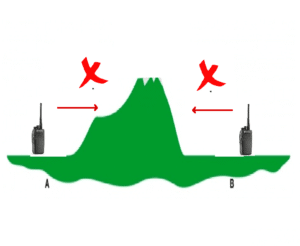
Tegan HarrisRadio waves — whether digital or analog — travel in straight lines, a principle known as line of sight. Trees, hills, buildings, and sheer distance can all weaken or block a signal entirely. This is a real problem in motorsport, off-road racing, and commercial operations across New Zealand and Australia where terrain is often challenging.
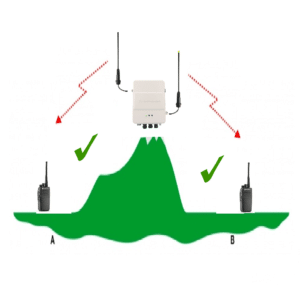
Two-way radio repeaters solve this problem by receiving a signal and re-transmitting it at higher power, dramatically extending range and coverage. Harris Race Radios supplies and programs Motorola repeater systems for motorsport teams and commercial operators throughout NZ and AU.
What Is a Radio Repeater?
A radio repeater simultaneously receives a radio signal on one frequency (the input frequency) and re-transmits it at higher power on a second frequency (the output frequency). Radios in the field are programmed to transmit on the repeater's input and receive on its output — allowing communication well beyond normal handheld or mobile radio range.
Repeater antennas are typically mounted at height — on a hilltop, tower, or tall building — to maximise line-of-sight coverage across the widest possible area.
How Does a Motorola Digital Repeater Work?
Motorola's digital repeaters — including the DR3000 and SLR1000 series — use the latest DMR (Digital Mobile Radio) technology to receive and re-transmit signals with minimal latency and maximum clarity. Digital repeaters offer significant advantages over analog systems:
- Cleaner audio at the edge of coverage (digital holds signal longer before dropping)
- Two simultaneous talk paths on one channel (DMR time-slotting)
- Encryption and private channel capability
- Available in UHF and VHF — see our UHF vs VHF guide to choose the right frequency for your application
Where Are Repeaters Used?
Repeater systems are used wherever standard radio range is insufficient:
- Motorsport events — endurance racing, rally, off-road, and circuit events where pit-to-car or marshal communications need to cover a full circuit or stage
- Off-road racing in NZ & AU — hilly or forested terrain where direct line-of-sight is impossible
- Commercial operations — warehouses, hotels, large sites, and transport fleets
- Emergency services and public safety
Installing a Radio Repeater
Installation complexity depends on the configuration. Most motorsport and club-level setups use a single-antenna repeater with a duplexer — a filter that allows the unit to transmit and receive simultaneously on one antenna. This is the simplest and most portable option, ideal for event-based use.
High-power fixed installations use two separate antennas — one for receive, one for transmit — spaced at least 2.5 metres apart vertically to prevent interference between them.
Key installation principles:
- Mount the antenna at the highest practical point within your coverage area
- Minimise antenna cable length — longer runs mean more signal loss
- Position the repeater centrally to the area you need to cover
- Ensure line-of-sight to as many radio users as possible
Repeater Site Survey
Before committing to a repeater installation, a site survey and radio coverage test are essential. This identifies the optimal antenna location, confirms coverage across your required area, and avoids costly repositioning later. Harris Race Radios can assist with site surveys and repeater programming for motorsport events and permanent installations across NZ and AU.
Do You Need a Repeater?
Not every application needs one. If your radios are communicating reliably within range, a repeater adds unnecessary complexity. But if you're experiencing dropped communications, weak signal at distance, or coverage gaps in hilly or built-up terrain — a repeater is the right solution.
For advice on whether a repeater suits your setup, call Rex Harris on +64 21 682 912 or Aaron Harris on +64 27 449 9654. Harris Race Radios is RSM-approved to engineer NZ radio licences and can advise on licensing requirements for repeater operation.
Related Guides
- UHF vs VHF for Off-Road Racing in NZ & AU
- How to Choose a Race Radio System in NZ & Australia
- Radio Licence Q&A
- Shop Motorola Repeaters & Radio Systems
Harris Race Radios — Motorsport Communications & Radio Systems Specialists | New Zealand & Australia