Technical Information & FAQs
Motorsport communications knowledge for New Zealand and Australia
Start with our motorsport communications services and technical knowledge guide for practical advice on circuit-racing radios, official race-radio and RMC monitoring, intercoms, DSP noise processing, helmet audio and complete-system selection. It explains our recommendations across Rugged Radios, PCI, ZeroNoise and Stilo, with entry-level through professional options for your application.
Technical Pages
How to Install High Powered Radios
How to Install Antennas Correctly.
How to install Rugged Radios Antenna
Manuals
Rugged Radios Intercom and User Manuals
ZeroNoise Manuals & Downloads — Fearless WW & Pit-Link
Alfano Manuals & Documentation
Frequently Asked Questions
5 Way or 4-way Plug?

The photo above shows a five-contact plug: the metal contacts are separated by four insulating bands. This is not a photo of a four-contact plug.
Four-way and five-way connectors can have different wiring and applications. A matching plug shape does not establish the microphone, speaker or PTT connections. Harris Race Radios™ can identify your helmet, headset, radio or intercom connection and advise on a suitable adaptor or cable.
Send us a clear photo of the plug and the equipment model details so we can help match the connection correctly.
Why we recommend Motorola digital TDMA radios for circuit racing
Motorola professional digital radios deliver clearer voice communication in noisy race cars. Their noise-cancelling technology helps separate the driver’s voice from background noise, while digital error correction helps recover speech affected by radio interference. Clearer messages mean fewer repeated calls and more attention on driving.
The Motorola radios we use employ TDMA technology, providing efficient battery use and increased channel capacity. These are real advantages during long race days and endurance events.
For professional circuit racing, Motorola is our first choice. Its combination of noise cancellation, digital error correction and TDMA performance is why we recommend it, backed by our experience engineering, installing and repairing complete motorsport communications systems.
Motorsport Radios, How They Work
This is a simplified introduction to two-way radio transmission.
Both analogue and digital radios send radio-frequency signals, commonly using VHF or UHF bands. Analogue FM carries variations corresponding to the voice signal. A digital voice radio encodes speech as digital information and transmits it using its supported modulation and radio protocol. Compatible radios must use matching frequencies, modes and system settings.
The Motorola TDMA systems we use divide a radio channel into two time slots. This is the foundation of their channel-capacity and transmitter-efficiency benefits. Digital modulation and time-slot operation are separate concepts; the diagrams below are simplified illustrations of analogue and digital signalling.


The practical differences matter most when choosing equipment for your car, team and event.
Feature Comparisons
Voice Quality
Motorola's professional speech processing helps separate the driver's voice from cockpit noise, while digital error correction helps recover damaged information in the received radio signal. Together, these capabilities support clear, intelligible messages and reduce the time spent repeating instructions. Digital reception also reduces the background hiss associated with weak analogue signals across much of the usable coverage area.
This is a key reason we recommend Motorola for professional circuit racing. Noise at the microphone and interference affecting the radio signal are different challenges, so we address both through the radio platform, microphone placement, helmet audio and installation. Error correction has limits, but its ability to recover usable speech is a real benefit, not a reason to dismiss digital performance.
Coverage
Digital voice can remain consistent across much of the service area where an analogue signal becomes progressively noisier. That makes important pit-to-car and car-to-pit instructions easier to understand. Motorola's professional platform, correctly installed and matched to the vehicle, is our preferred starting point for circuit-racing communications.
We plan usable coverage around the antenna location and tuning, course, terrain, vehicle shielding, interference and receiver performance, rather than transmitter wattage alone. DMR coverage can be comparable to narrowband analogue coverage, with better perceived speech quality over much of that area. At the reception limit, digital audio can break up or drop out. The diagram below illustrates the general difference, not a measured range for a particular circuit.
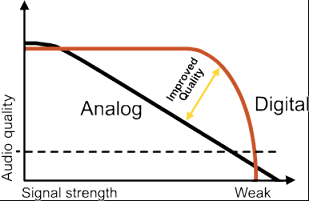
The faster you go and the more noisy your car, the better radios you need. Speed-related radio effects such as Doppler and changing multipath conditions affect the radio link; cockpit and engine noise affect speech pickup. A professional radio and a correctly engineered helmet-audio and antenna installation address these different demands as a complete system.
Battery Life
The Motorola TDMA platform we use improves transmitter efficiency because a call occupies one of two time slots rather than transmitting continuously throughout the call. Motorola documents up to 40% longer operation in specified TDMA comparisons. This is a useful advantage for long race days and endurance events, alongside the platform's speech and system capabilities.
We select battery capacity and spare-battery or charging arrangements for the actual shift. Runtime depends on the radio model, battery condition, transmit power and transmit/receive/standby duty cycle; the published percentage is a specified comparison, not a fixed improvement in every installation.
Channel Capacity
Two-slot Motorola DMR TDMA systems can provide two logical communication paths within a 12.5 kHz radio channel when configured for supported two-slot operation. This makes more efficient use of the available channel capacity and is another practical reason we recommend the professional Motorola platform.
We configure the equipment and supported system mode for the team's needs rather than assuming every direct radio-to-radio arrangement provides two independent calls. Talkgroups and addressing organise calls; confidentiality requires appropriate supported privacy or encryption features and configuration. Disciplined radio use still matters when urgent instructions need to get through.
Other model-dependent features can include text messaging, GPS location, radio identification and individual or group calls. We can advise which functions are useful for your team rather than adding complexity you do not need.
Are Analog and Digital Compatible?
An analogue-only radio cannot directly decode a digital voice transmission. Many professional Motorola digital radios also support analogue operation, allowing a staged upgrade when both radios are configured for a compatible analogue mode. Digital operation requires matching radio protocols and system settings.
Harris Race Radios™ can help you match existing radios, helmet audio, intercoms and team requirements before changing equipment. Our recommendation comes from radio engineering and practical motorsport installation, fault-finding and repair experience. For professional circuit racing, Motorola TDMA is our first choice because its combined speech clarity, error correction, battery efficiency and system capabilities support the job the team needs to do.

Technical references
Motorola MOTOTRBO system specifications describe TDMA capacity and model-specific battery benefits. Tait's DMR technical FAQs explain DMR and analogue coverage considerations.