
Antenna & Aerial Installation, Tuning & Testing — Harris Race Radios
Antennas & Aerials — The Unsung Heroes of Radio Communication
You can have the best radio in the world, but if your antenna is poorly installed, incorrectly tuned, or the wrong type for your application, your communication system will underperform. Most people never think about their antenna — and that's exactly where performance is won or lost.
At Harris Race Radios, we don't just sell antennas. We install them, tune them, and verify them with professional-grade test equipment. Rex Harris is a New Zealand radio telecommunications engineer and licensed amateur radio operator with over 30 years of experience in motorsport radio systems. When it comes to antenna selection, installation, and tuning for racing applications in New Zealand and Australia — nobody does it better.
Not All Antennas Are Created Equal
Walk into any auto parts store and you'll find antennas. Most of them are generic, untested, and optimised for nothing in particular. In a motorsport environment — where you're dealing with vibration, RF interference from ignition systems, close-proximity vehicles, and the need for reliable communication at range — antenna selection and installation is an engineering decision, not a shopping one.
- Gain matters — a higher-gain antenna extends range in flat terrain but narrows the radiation pattern. Wrong gain for your application means dead spots.
- Impedance matching matters — a mismatched antenna reflects power back into your radio, reducing output and potentially damaging the transmitter over time.
- Mount location matters — ground plane, cable routing, proximity to metal structures, and connector quality all affect SWR and real-world performance.
- Cable quality matters — cheap coax introduces loss. At UHF frequencies, even a short run of poor-quality cable can cost you significant signal strength.
- Tuning matters — an antenna that measures correctly on the bench may perform differently once installed in a vehicle. Professional SWR measurement after installation is the only way to verify performance.
Professional Test Equipment — We Verify What We Install
Harris Race Radios uses professional-grade RF test equipment to verify every antenna installation and system we supply. This includes SWR meters, power meters, and frequency analysers calibrated for UHF and VHF motorsport frequencies.

The Rugged Radios SWR-METER-D is the professional standard for UHF/VHF antenna testing in motorsport applications. It measures:
- SWR (Standing Wave Ratio) — the key indicator of how well your antenna is matched to your radio and cable system. A perfect match is 1:1. Anything above 2:1 means you're losing significant power and potentially stressing your transmitter.
- Forward and reflected power — shows exactly how much power is being radiated versus reflected back.
- Frequency — confirms the antenna is resonant at the correct operating frequency for your application.
Every antenna system Harris Race Radios installs or supplies is tested and verified with this equipment before it leaves our workshop. We provide SWR readings on request.
Radio Spectrum Management Licensed — NZ Compliance

Harris Race Radios operates under a Radio Spectrum Management (RSM) licence — the New Zealand government authority responsible for managing the radio frequency spectrum. Rex Harris holds an amateur radio licence and has operated under RSM compliance for over 30 years.
This means every antenna and radio system we supply for use in New Zealand is configured and verified to operate within legal frequency and power limits. We don't guess — we measure, verify, and certify.
For Australian customers, all systems are configured for ACMA (Australian Communications and Media Authority) compliance. We understand both regulatory environments and configure every system accordingly.
Harris Race Radios Workshop — Repeaters, Test Rigs & Professional Infrastructure

This is what a professional motorsport radio workshop looks like. Harris Race Radios operates Motorola DR3000 digital repeater infrastructure, professional SWR and power measurement equipment, and a full suite of test and programming tools for Rugged Radios and Motorola systems.
We don't just sell radio equipment — we operate it, test it, and use it at race events throughout New Zealand and Australia. When you buy from Harris Race Radios, you're buying from people who understand radio engineering from the ground up.
Rugged Radios Antenna Installation Guide
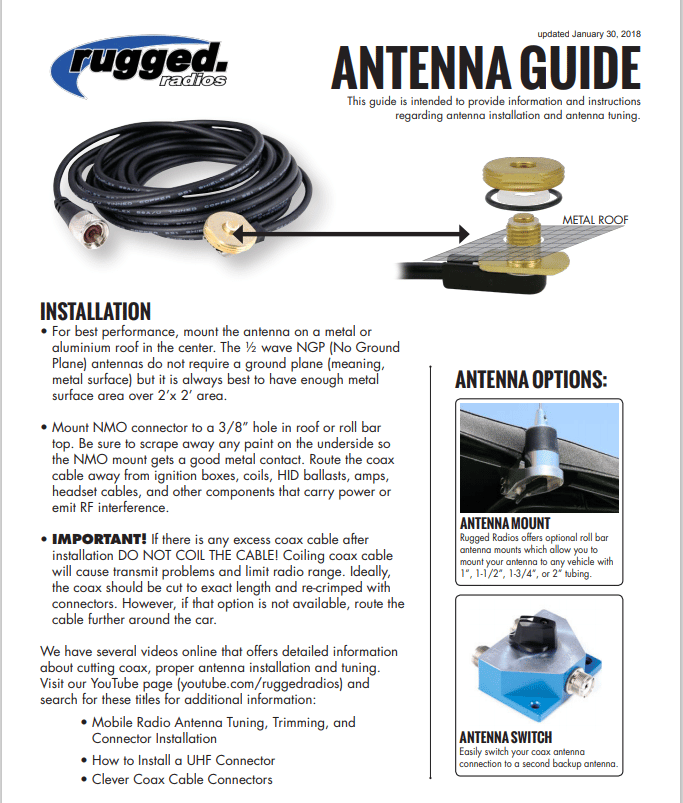
The three most critical factors in antenna performance are mounting location, grounding, and cable routing. Get these right and your system will perform as designed. Get them wrong and even the best antenna in the world will underperform.

- Mounting location — mount as high as possible, in the centre of a metal roof. Use yellow race coax. Never coil or bundle excess cable.
- Grounding — the antenna mount must contact bare metal. No powder coating, no paint, no corrosion. Poor ground = reduced range.
- Cable routing — route antenna cable independently from all other cables. Keep away from power, intercom, ignition, and ground cables. Never coil or bundle excess — order the correct length from the start.

Common Antenna Installation Mistakes
- No ground plane — UHF antennas require a metal ground plane. Mounting on fibreglass or plastic without a ground plane significantly degrades performance.
- Kinked or crushed coax — coaxial cable must be routed without sharp bends. A kinked cable changes impedance and introduces loss.
- Poor connector termination — a badly crimped PL-259 or N-connector is one of the most common causes of high SWR. We use professional crimping tools and verify every connector.
- Wrong cable length — cable length affects impedance. In some installations it needs to be calculated, not just cut to fit.
- Antenna too close to metal structures — proximity to roll cages, roof racks, and body panels detunes the antenna and distorts the radiation pattern.
- Never testing after installation — the most common mistake. Always verify SWR after installation. If you don't measure it, you don't know if it's working.
Frequently Asked Questions
What is SWR and why does it matter for my race radio?
SWR (Standing Wave Ratio) measures how well your antenna is matched to your radio and cable system. A high SWR means power is being reflected back into your radio instead of being radiated — reducing range and potentially damaging your transmitter. A correctly tuned antenna should measure below 1.5:1 SWR at your operating frequency.
Can Harris Race Radios tune my existing antenna?
Yes. If your existing installation is underperforming, we can measure the SWR, identify the cause, and advise on the correct fix — repositioning, re-terminating connectors, replacing cable, or selecting a different antenna. Contact us to discuss your setup.
What antenna do I need for Finke Desert Race or AORC events?
Offroad racing events like Finke and AORC require antennas that handle vibration, dust, and the physical demands of desert racing while maintaining reliable communication at range. Rex Harris can recommend the correct antenna, mount, and cable configuration for your vehicle class and event. Contact us before you buy.
Do you supply and install antennas for vehicles in Australia?
Yes. Harris Race Radios supplies antenna systems throughout Australia and New Zealand. For remote customers we can advise on correct installation and verify your setup via SWR readings you provide. For NZ-based customers we offer in-workshop installation and testing.
What is the difference between a UHF and VHF antenna?
UHF (400–520 MHz) is the standard for CB radio and most motorsport communication in Australia and New Zealand. VHF (136–174 MHz) is used in some specific motorsport and aviation applications. Using a VHF antenna on a UHF radio will result in very high SWR and poor performance.
Shop Rugged Radios Antennas
Shop Rugged Radios Antennas & Mounts → | Shop Antenna Cables, Connectors & Bases →